Audi 2.0 TDI Oil Pump Failure Symptoms and Repair Cost
Audi 2.0 TDI Oil Pump Failure Symptoms and Repair Cost
- October 1, 2026
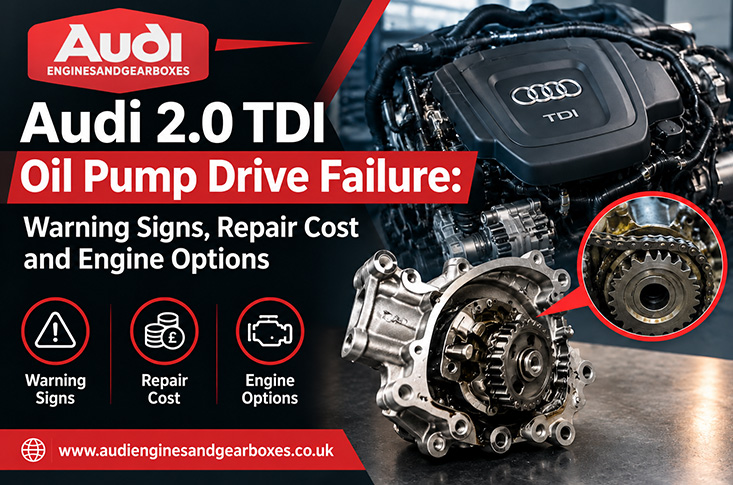
Audi 2.0 TDI Oil Pump Drive Failure: Warning Signs, Repair Cost and Replacement Engine Options
Who Should Use This Guide and When
This guide is for UK Audi 2.0 TDI owners responding to an oil-pressure warning, used-car buyers checking a vehicle before purchase, fleet operators assessing downtime and repair value, and independent garages advising customers on diagnosis. Use it to decide whether the car should be recovered immediately, which workshop tests to authorise, whether an oil pump drive repair is sufficient, and when the evidence supports comparing an engine rebuild with a correctly matched replacement engine.
Author and editorial owner: Audi Engines & Gearboxes Editorial Team. Technical review scope: UK Audi 2.0 TDI fault diagnosis, repair-versus-replacement decisions, engine compatibility checks and replacement-engine sourcing guidance.
Last updated: 1 October 2026
What Causes Audi 2.0 TDI Oil Pump Failure
Short answer: on affected Audi 2.0 TDI engines, a worn oil pump drive can cause a sudden loss of oil pressure. If the warning appears, stop the engine and arrange recovery; continued driving can damage the bearings, crankshaft and turbo within minutes. A timely Audi 2.0 TDI oil pump repair may cost far less than a rebuild or replacement Audi engine. Audi Engines & Gearboxes helps UK drivers compare Audi engine prices from verified suppliers when repair is no longer economical.
Common Warning Signs of Oil Pump Drive Failure
- Oil pressure warning flickering at hot idle.
- A rattle or whine from the front of the engine.
- Oil light that appears briefly after a cold start.
- Metal sheen in the oil at service time.
- Any fault code relating to oil pressure or camshaft timing.
If the Audi oil pressure warning appears, stop driving immediately. Even an intermittent warning can indicate a failing drive, weak pump, blocked pickup or internal wear. A mechanical oil-pressure test is the safest next step.
Which Audi engines are affected?
| Engine code | Common in | Years | Risk |
| CAGC | A4 B8 | 2009–2015 | High — drive wear documented |
| CJCA | A4 B8, A5 | 2012–2015 | High |
| CGLC | A6 C7 | 2011–2015 | Moderate |
| CNHA | A6 C7 | 2014–2018 | Moderate |
| DEUA / DETA | A4 B9, Q5 FY | 2015 onward | Lower — revised design |
Confirm the Audi engine code against the REG or vehicle registration checker and parts data before ordering components or a replacement unit. The exact code matters because compatibility can vary by model, production year, power output and emissions equipment.
How Audi 2.0 TDI Oil Pump Failure Is Diagnosed
A proper diagnosis starts with a mechanical oil-pressure test rather than relying only on the dashboard warning or a fault-code scan. The technician should record pressure at cold start, hot idle and around 2,000 rpm, then compare the readings with the specification for the exact engine code. If pressure is low, the next checks are the oil level and condition, pressure switch and wiring, sump pickup, oil pump drive and pump. Metal debris, turbo noise or bearing knock indicates that the investigation must also cover oil-starvation damage.
Diagnostic decision path
- Warning appears: switch off the engine and arrange recovery.
- Check basics: confirm the oil level, correct oil specification and any obvious leak.
- Measure pressure: test cold, at hot idle and at 2,000 rpm.
- Inspect the sump: check the pickup for blockage and the drive and pump for wear.
- Assess secondary damage: inspect bearings, crankshaft and turbo if pressure has been lost.
- Choose the remedy: repair the drive and pump when the engine is sound; compare rebuild and replacement-engine costs when internal damage is present.
Example: intermittent warning at hot idle
For example, an Audi A4 that shows an oil-pressure warning only after a motorway run may still sound normal when cold. If a mechanical test confirms marginal pressure at hot idle and sump inspection finds a worn drive but no bearing debris, replacing the updated drive, pump where necessary, pickup seals, oil and filter may save the engine. If the same inspection reveals metallic debris or crankshaft-bearing damage, approving only the pump repair risks paying twice; a complete rebuild or correctly matched replacement engine should be priced before work continues.
Repairing the Oil Pump or Replacing the Engine
Repair is usually the better option when the warning is caught early and oil-pressure testing shows no internal damage. If oil starvation has damaged the bearings, crankshaft or turbo, compare the total rebuild cost with quotes for a used Audi engine, reconditioned Audi engine or complete Audi 2.0 TDI replacement engine.
- Sump removal and oil pump access.
- Inspection of the drive, chain or keyway and the pump itself.
- Replacement of the drive with the updated part.
- New oil pump if the old one shows wear.
- Fresh oil, filter and a documented oil pressure test afterwards.
How Much Does Audi 2.0 TDI Oil Pump Repair Cost
Short answer: an Audi 2.0 TDI oil pump repair cost can range from about £600 to £1,800 when the drive or pump is repaired before major engine damage. If oil starvation has already damaged internal components, a rebuild or replacement Audi engine may be more economical. The table below shows the guide ranges used in this article.
| Route | Cost | Outcome |
| Drive replacement with updated part | £600–£1,400 | Engine saved |
| Drive plus oil pump | £900–£1,800 | Engine saved |
| Bearing damage from oil starvation | £2,000–£3,500 | Rebuild or replacement |
| Replacement Audi engine fitted | £1,300–£3,800 | New engine in an old car |
How do you check an Audi before buying it?
Before you compare Audi 2.0 TDI engine prices, request a hot oil-pressure reading, listen for cold-start rattle and review the service history. Confirm the engine code and ask whether the oil pump drive has been inspected or updated. Frequent, correct-specification oil changes are a stronger sign of care than long-interval servicing alone.
How do you avoid this failure in the first place?
- Oil and filter every 6,000–8,000 miles, not 18,000.
- Correct specification oil for the engine.
- Investigate any oil pressure warning the same day.
- Ask a specialist to check the drive at 80,000 miles.
- Keep records; they matter at resale.
Key takeaway: an Audi 2.0 TDI oil-pressure warning can indicate oil pump drive failure and should be treated as urgent. Stop the engine, confirm the fault with a mechanical oil-pressure test and compare repair costs with Audi replacement engine prices if internal damage is found.
Frequently Asked Questions
Can You Drive with an Oil Pump Fault
No. Do not drive with an intermittent oil-pressure warning. Stop the engine, arrange recovery and have the oil pressure and pump drive checked before restarting it.
How much is the repair?
An Audi 2.0 TDI oil pump drive repair commonly costs about £600–£1,400 in the ranges used in this guide, or around £900–£1,800 when the oil pump also needs replacement. The final quote depends on the engine code, damage, labour and parts required.
Does every 2.0 TDI suffer from this?
No, but the affected codes are common enough that we check every one we see. Revised designs from later builds are much less prone.
Is a replacement engine the only option if the drive has failed?
No. If the engine is stopped quickly and internal damage is limited, repairing the drive and oil system may be enough. If oil starvation has damaged the bearings, crankshaft or turbo, compare the cost of a rebuild with a used, reconditioned or replacement Audi engine.
How do I know the updated part has been fitted?
Ask for the part number on the invoice and a before-and-after oil pressure reading. A specialist will have both.
How often should the pump drive be checked?
At every major service on an affected code, and specifically at 80,000 miles. It is a visual and pressure check rather than a strip, and a specialist will complete it alongside an oil service.
What does a specialist look for during the check?
- Oil pressure at hot idle, recorded.
- Drive and pump condition through the sump.
- Metal debris in the oil and on the pickup.
- Condition of the oil itself: contamination, fuel dilution, sludge.
- Whether an updated drive is already fitted.
What if the drive looks fine but the pressure is low?
Then the pump itself, the pickup or the bearings are suspect, and the diagnosis continues before anything is replaced. Replacing a drive when the pump is the problem simply repeats the fault.
How do I protect an engine that has already had a drive failure?
Fit the updated drive, replace the pump if it shows wear, change the oil and filter immediately, and then keep to short oil intervals for the life of the car. Once an engine has run dry for even a few seconds, bearing inspection is part of the job rather than an optional extra.
Is it worth repairing an Audi after an oil starvation event?
If the drive is caught immediately and the bearings are inspected and found sound, yes. If the bearings or crank are damaged, the honest advice is a replacement engine or a rebuild, and the numbers decide which.
What does the oil pressure test actually measure?
A gauge is fitted in place of the oil pressure switch, and readings are taken at cold start, at hot idle and at 2,000 rpm. Those three numbers tell a specialist whether the pump, the drive or the bearings are the problem, and they take twenty minutes.
| Reading | Healthy range guidance | What low means |
| Cold start | Rises quickly to spec | Slow build suggests pump or drive |
| Hot idle | At or above specification | Low means wear or pump weakness |
| 2,000 rpm | At or above specification | Low under load confirms damage |
What should the workshop do if the pressure is marginal?
Investigate further rather than reassure. Marginal pressure at hot idle on one of these engines is a warning, not a coincidence, and the next step is a sump inspection to see the drive and check the pickup for debris.
How much does the inspection cost?
Typically £120–£250 including the pressure test and a sump inspection where access allows. Against the cost of a replacement engine, it is the best value in the whole diagnosis.
What parts should be replaced with the drive?
- The updated drive and any associated chain or keyway.
- The oil pump if it shows wear.
- The pickup and seals.
- Oil, filter and sump gasket.
- Coolant is not disturbed on this job, unlike many others.
How do I know the repair has worked?
Ask for a hot oil pressure reading after the repair and compare it with the reading taken before. A specialist will provide both, and that comparison is your evidence that the fault is genuinely fixed rather than masked.
Does the failure affect the turbo as well?
Often, yes. Oil starvation that stops the engine also starves the turbo, and a turbo damaged by low oil pressure can fail weeks later. Ask the workshop to inspect the turbo shaft play and the oil feed pipe at the same time as the drive repair.
What is the one-line answer on the 2.0 TDI oil pump drive?
Take the oil pressure warning seriously the first time you see it, and have the drive checked; the repair is a fraction of a replacement engine.
Which Audi owners are most at risk?
Owners with long service intervals and short journeys. The oil degrades faster than the schedule assumes, and the drive wears faster than the oil suggests. If your car has 15,000-mile oil changes or longer and does mostly town miles, the check is worth booking at your next service.
| Risk factor | Why it matters |
| Oil changes over 10,000 miles | Faster drive and pump wear |
| Mostly short journeys | Oil never reaches temperature |
| 80,000+ miles | Wear becomes measurable |
| Any oil pressure warning | The failure has started |
| Cheap or wrong-spec oil | Accelerates everything above |
Is the oil pump drive a service item?
No, but it is an inspection item on affected codes. Ask for it to be checked at every major service once the car passes 80,000 miles, and take the oil pressure reading seriously if it ever appears on the dashboard.
What is the single most important habit for an Audi 2.0 TDI owner?
Short oil intervals. Every drive and pump failure we see has been accelerated by long service intervals and short journeys, and the oil is the cheapest component in the whole chain of parts.
Does the repair need a new timing belt too?
If the belt is due or the engine is apart, yes. Doing both in one visit is cheaper than two visits, and it protects the money you have just spent on the drive and pump.
Related Questions Before Approving the Repair
What evidence should be included in the workshop quote?
Ask for the measured oil-pressure readings, photographs of the drive and pickup, the engine code used for parts matching, a list of included seals and fluids, and written warranty terms. If a replacement engine is proposed, confirm mileage evidence, condition, ancillaries included, delivery, fitting, VAT and the labour warranty before comparing headline prices.
Can a diagnostic scan confirm oil pressure?
No. A scan may show a related fault or the state of an electronic switch, but it does not replace a calibrated mechanical pressure test. An engine can have dangerous hot-idle pressure without storing a useful code.
Need an Audi replacement engine after oil pump failure?
If oil pump failure has caused major internal damage, use Audi Engines & Gearboxes to compare replacement Audi engine quotes from verified UK suppliers for a compatible engine.
Compare engine conditions: a used engine may provide a lower upfront price, while a reconditioned or remanufactured unit may offer more extensive inspection and parts renewal.
Match the engine correctly: provide the REG, engine code, fuel type, power output and transmission details before purchase.
Check what the quote includes: engine supply, delivery, fitting, fluids, ancillary parts, VAT and warranty terms should be stated clearly before you choose a supplier.
Get Audi engine quotes: enter the vehicle registration on Audi Engines & Gearboxes to compare Audi engine prices, review compatible used and reconditioned Audi engines, and confirm the warranty, delivery and fitment details directly with the selected supplier.


