Cleaned, Pressure-Washed, and Clocked: How to Buy a Reconditioned Audi A2 Engine Without Getting Scammed
Cleaned, Pressure-Washed, and Clocked: How to Buy a Reconditioned Audi A2 Engine Without Getting Scammed
- June 23, 2026
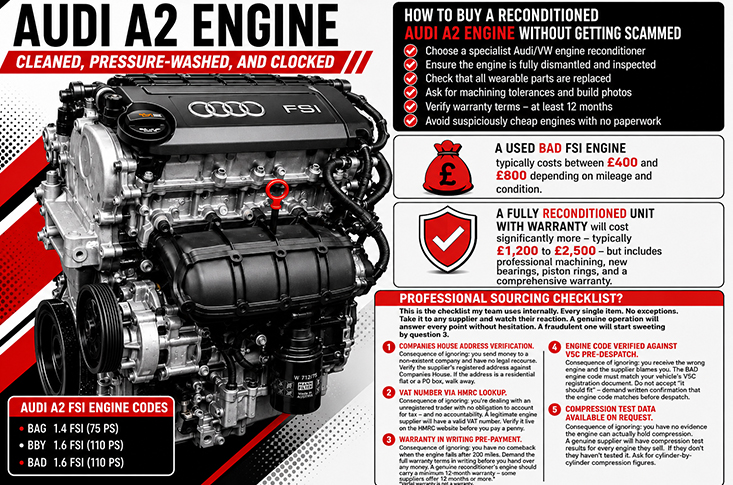
A Pressure Wash Doesn't Fix Worn Bearings: The 9 Precise Checks That Filter Out Disguised High-Mileage Duds
Quick Answer Box — The 30-Second Verdict
Buying a reconditioned Audi A2 engine without insider knowledge is like buying a used car in the dark. The BAD FSI 1.6-litre unit is one of the most complex and sensor-dependent engines Audi ever produced — and fraudulent suppliers know exactly how to disguise high-mileage duds with a pressure washer and a rattle can. The only way to buy safely is to follow a professional sourcing checklist that makes deception structurally impossible. This guide gives you the exact 9 checks my team uses internally. Take this checklist to any supplier. A genuine one will welcome every question. An illegitimate one will become evasive before question 3.
A Pressure Wash Doesn't Fix Worn Bearings: The 9 Precise Checks That Filter Out Disguised High-Mileage Duds
You're about to know what the sourcing team at a genuine engine supplier checks every single time. Most buyers never get this. But you're not most buyers.
Here's the uncomfortable truth: the Audi A2 BAD FSI is a 110bhp, 1.6-litre direct-injection petrol engine produced between 2002 and 2005. It is technologically sophisticated, heavily sensor-dependent, and notoriously temperamental when poorly maintained. It is also — and this is critical — an engine that fraudulent sellers actively target because they know most buyers have no way to verify a reconditioning claim without specialist equipment.
The scam is simple. A high-mileage BAD FSI engine — 120,000, 150,000, even 200,000 miles — is pulled from a written-off donor. It's pressure-washed until it gleams. The block is repainted in fresh silver. New stickers are applied. Online photos are carefully angled to hide the truth. And it's listed as a "reconditioned Audi A2 engine" with a convincing story about low mileage and careful maintenance.
A pressure wash doesn't fix worn bearings. Paint doesn't reseat piston rings. And a new sticker doesn't undo 150,000 miles of carbon buildup in the intake manifold.
This guide arms you with the exact professional checks that see through every disguise. By the time you finish reading, you will be impossible to fool and every fraudulent competitor impossible to hide.
Why Does a Visual Inspection Tell You Absolutely Nothing About a Reconditioned Audi A2 Engine's Real Condition?
Here's what most buyers don't realise until it's too late: a "reconditioned Audi A2 engine" that looks perfect in photographs can be a mechanical time bomb underneath.
The cosmetic disguise technique is alarmingly effective. Fraudulent yards and private sellers will:
- Pressure-wash the entire engine block to remove all evidence of oil leaks, coolant stains, and general age.
- Repaint the block and cylinder head in fresh silver or black, making 150,000 miles look like 50,000.
- Replace or clean external stickers and labels to hide the engine's true age.
- Photograph the engine from carefully selected angles that hide damage, corrosion, or wear.
- List the engine with vague condition descriptions like "perfect running condition" or "tested and working" — phrases that mean absolutely nothing legally.
The BAD FSI engine has specific visual tells that a pressure wash cannot hide — but you need to know where to look. Carbon deposits around the intake manifold flaps are a known issue on high-mileage FSI units. A pressure wash won't remove internal carbon. The variable intake butterflies (flaps) are a common failure point, and no amount of external cleaning will fix a seized flap mechanism.
What Must You Verify Before Paying for Any Reconditioned Audi A2 Engine — The 9-Point Professional Sourcing Checklist?
This is the checklist my team uses internally. Every single time. No exceptions. Take it to any supplier and watch their reaction. A genuine operation will answer every point without hesitation. A fraudulent one will start sweating by question 3.
1. Companies House address verification. Consequence of ignoring: you send money to a non-existent company and have no legal recourse. Verify the supplier's registered address against Companies House. If the address is a residential flat or a PO box, walk away.
2. VAT number via HMRC lookup. Consequence of ignoring: you're dealing with an unregistered trader with no obligation to account for tax — and no accountability. A legitimate engine supplier will have a valid VAT number. Verify it live on the HMRC website before you pay a penny.
3. Warranty in writing pre-payment. Consequence of ignoring: you have no comeback when the engine fails after 200 miles. Demand the full warranty terms in writing before you hand over any money. A genuine reconditioned engine should carry a minimum 6-month warranty — some suppliers offer 12 months or more. "Verbal warranty" is not a warranty.
4. Engine code verified against V5C pre-despatch. Consequence of ignoring: you receive the wrong engine and the supplier blames you. The BAD engine code must match your vehicle's V5C registration document. Do not accept "it should fit" — demand written confirmation that the engine code matches before despatch.
5. Compression test data available on request. Consequence of ignoring: you have no evidence the engine can actually hold compression. A genuine supplier will have compression test results for every engine they sell. If they don't, they haven't tested it. Ask for cylinder-by-cylinder compression figures.
6. Storage conditions disclosed. Consequence of ignoring: you receive an engine that has been sitting outside in the rain for six months, with internal corrosion you can't see. Ask exactly where and how the engine has been stored. Indoors, on a pallet, under cover? Or in a muddy yard?
7. Mileage verification method explained. Consequence of ignoring: you pay a premium for "low mileage" that cannot be proven. Ask how the mileage was verified. Was it from the donor vehicle's MOT history? The instrument cluster? The service records? "We were told it was low mileage" is not verification — it's hearsay.
8. Returns policy — who pays return shipping. Consequence of ignoring: you're stuck with a faulty engine because return shipping to a distant supplier costs £200+ and the supplier knows you won't bother. Demand written confirmation of who pays for return shipping if the engine is faulty. If the answer is "you do," find another supplier.
9. Fitting warranty — what voids it. Consequence of ignoring: you have the engine fitted by a non-approved garage and the warranty is voided without you knowing. Ask for the exact list of conditions that void the warranty. A fair warranty will require professional fitting by a VAT-registered garage. An unfair one will have so many exclusions it's effectively worthless.
The Challenge Trigger: Take this checklist to any supplier. A genuine one will welcome every question. An illegitimate one will become evasive before question 3. If they can't answer question 5, leave immediately.
What Must You Demand in Writing to Be Protected When Buying a Reconditioned Audi A2 Engine Under UK Law?
Under the Consumer Rights Act 2015, any goods you purchase must be of satisfactory quality, fit for purpose, and as described. A reconditioned Audi A2 engine is no exception.
But here's the problem: many suppliers will try to contract out of these protections with carefully worded small print. You need to know exactly what to demand in writing and what terms to never accept.
Template language to insist on in the invoice:
"This engine is sold as a reconditioned unit, having undergone professional disassembly, inspection, machining, and reassembly to manufacturer specifications. It is warranted to be free from defects in materials and workmanship for a period of [X] months from the date of delivery. This warranty covers the engine block, cylinder head, crankshaft, pistons, connecting rods, camshaft, and all internal components. Any failure of these components during the warranty period will result in a full refund or replacement at the buyer's discretion, with all shipping costs borne by the seller."
Red flag terms to never accept — quoted verbatim:
- "Sold as seen" — this is a complete disclaimer of any responsibility and is almost certainly an unfair contract term under UK law.
- "No returns after fitting" — this means if the engine fails after installation, you have no comeback. It is designed to protect the seller, not you.
- "Warranty void if fitted by third party without prior approval" — this gives the seller control over who fits the engine and can be used to void your warranty for any reason.
- "Warranty excludes ancillary components" — on the BAD FSI, the high-pressure fuel pump, injectors, and intake manifold flaps are known failure points. If these are excluded from warranty, you're inheriting someone else's problems.
How Do You Verify ULEZ Compliance and Donor Vehicle History Before Buying a Reconditioned Audi A2 Engine?
The Audi A2 1.6 FSI BAD meets Euro 3 emissions standards and emits 144 g/km of CO2. This makes it ULEZ compliant for most UK cities — but only if the engine is running correctly.
Here's the trap: a poorly maintained or high-mileage BAD FSI can fail emissions tests even though the engine type is technically compliant. Carbon buildup, faulty injectors, and failing sensors all push emissions beyond legal limits.
Pre-purchase verification steps:
- Check ULEZ compliance. Use the TfL ULEZ checker or AutoTrader's vehicle checker with the donor vehicle's registration number.
- Verify donor vehicle history. Use AutoTrader or HonestJohn to check the donor vehicle's MOT history. Look for:
- Repeated emissions test failures
- Engine management light advisories
- High recorded mileage that doesn't match the seller's claim
- MOT emissions pre-check. Before fitting the replacement engine, have a garage perform a pre-MOT emissions test on the bare engine (if possible) or immediately after installation. This will tell you if the engine can actually pass a UK MOT.
What a genuine supplier will always be able to show you: the donor vehicle's registration number, MOT history, and service records. If they can't or won't provide these, they're hiding something.
Explore More About Audi Engines
1 - Audi A1 is a Stunning Vehicle with Great Comfort and Reliability
2 - The Reconditioned Audi A5 Engine & Gearbox Checklist: Ensuring a Smooth and Reliable Ride
3 - Beyond the Price Tag: Why I Chose a Replacement Audi S4 Engine Supplier 'Near Me
4 - Audi A7 with Generous Space and Practicality
People Also Ask
What is the Audi A2 BAD FSI engine code?
The BAD engine code identifies the 1.6-litre, 110bhp, 16-valve, DOHC, direct-injection petrol engine fitted to the Audi A2 between 2002 and 2005. It is a four-cylinder inline engine with a displacement of 1,598cc.
How much does a reconditioned Audi A2 engine cost?
A used BAD FSI engine typically costs between £400 and £800 depending on mileage and condition. A fully reconditioned unit with warranty will cost significantly more — typically £1,200 to £2,500 — but includes professional machining, new bearings, piston rings, and a comprehensive warranty.
Is the Audi A2 1.6 FSI engine reliable?
The BAD FSI is reliable when properly maintained with premium fuel and regular servicing. However, it is complex and sensor-dependent, and common failure points include the high-pressure fuel pump, intake manifold flaps, injectors, and EGR valve. Poor maintenance and cheap fuel are the primary causes of failure.
What are the common problems with the Audi A2 1.6 FSI engine?
Common problems include misfiring on multiple cylinders, lack of power and difficulty revving, high-pressure fuel pump failure, carbon buildup in the intake manifold and bores, and failure of the variable intake manifold flaps.
Can I fit a different engine to my Audi A2?
Fitting a different engine code to an Audi A2 is technically possible but creates significant challenges. The ECU, wiring loom, fuel system, and emissions equipment are all engine-code specific. A wrong-code engine will not be legally compliant and will void any warranty. Always replace like-for-like with the BAD code.
Ready to Buy with Confidence?
You now know exactly what to check, what to demand in writing, and what red flags to walk away from. The difference between buying a genuine reconditioned Audi A2 engine and a pressure-washed dud is not luck — it's preparation. Take this checklist, use it ruthlessly, and never hand over a penny until every single point has been verified.
Get your free, no-obligation quote for a professionally reconditioned Audi A2 BAD FSI engine with full warranty — and we'll talk you through every check on this list.


